What no sponsorship in a job post means, and what it does not
A job post that says no sponsorship usually means no H-1B petition. It does not by itself rule out OPT, CPT or STEM OPT. Here is what each route asks of the employer.

A posting that says no sponsorship usually means the employer will not file a work-visa petition for you, most often an H-1B. It does not say, on its face, that you cannot work there on Optional Practical Training (OPT), Curricular Practical Training (CPT) or STEM OPT. Those routes run on different papers, so the real question is which one the employer means.
What sponsorship means on the government’s side
I read the H-1B, CPT and Justice Department pages that govern each route, and none of them defines “no sponsorship” as a job-post phrase. The phrase belongs to the employer, so its meaning follows whichever paperwork the employer has in mind.
For an H-1B, that paperwork is a petition: the employer or its agent submits Form I-129 to U.S. Citizenship and Immigration Services (USCIS). The cap is 65,000 new statuses or visas per fiscal year, plus 20,000 more for people with a U.S. master’s degree or higher. Universities, their affiliated nonprofits and nonprofit or government research organizations are cap-exempt.
| Route | Who applies | What the employer does | Employer petition listed |
|---|---|---|---|
| CPT | Your school authorizes it | Signs a cooperative agreement or a letter | None |
| Post-completion OPT | You, on Form I-765 | No employer is needed to request it | None |
| STEM OPT | You, on Form I-765 | Enrolls in E-Verify and signs Form I-983 | None |
| H-1B | The employer or its agent, on Form I-129 | Files the petition | Yes |
What the phrase does not rule out
CPT needs a signed cooperative agreement or a letter from the employer, and your school authorizes it in the Student and Exchange Visitor Information System (SEVIS). The page lists no petition. One poster put the confusion plainly: “many companies don’t fully understand how CPT doesn’t require any actual sponsorship from the company, and they just add this blindly.”
Post-completion OPT can be requested without an employer. The Student and Exchange Visitor Program says students are not required to have one, though they are expected to be employed and can be unemployed for a total of 90 days. The authorization runs up to 12 months, and you file Form I-765 yourself.
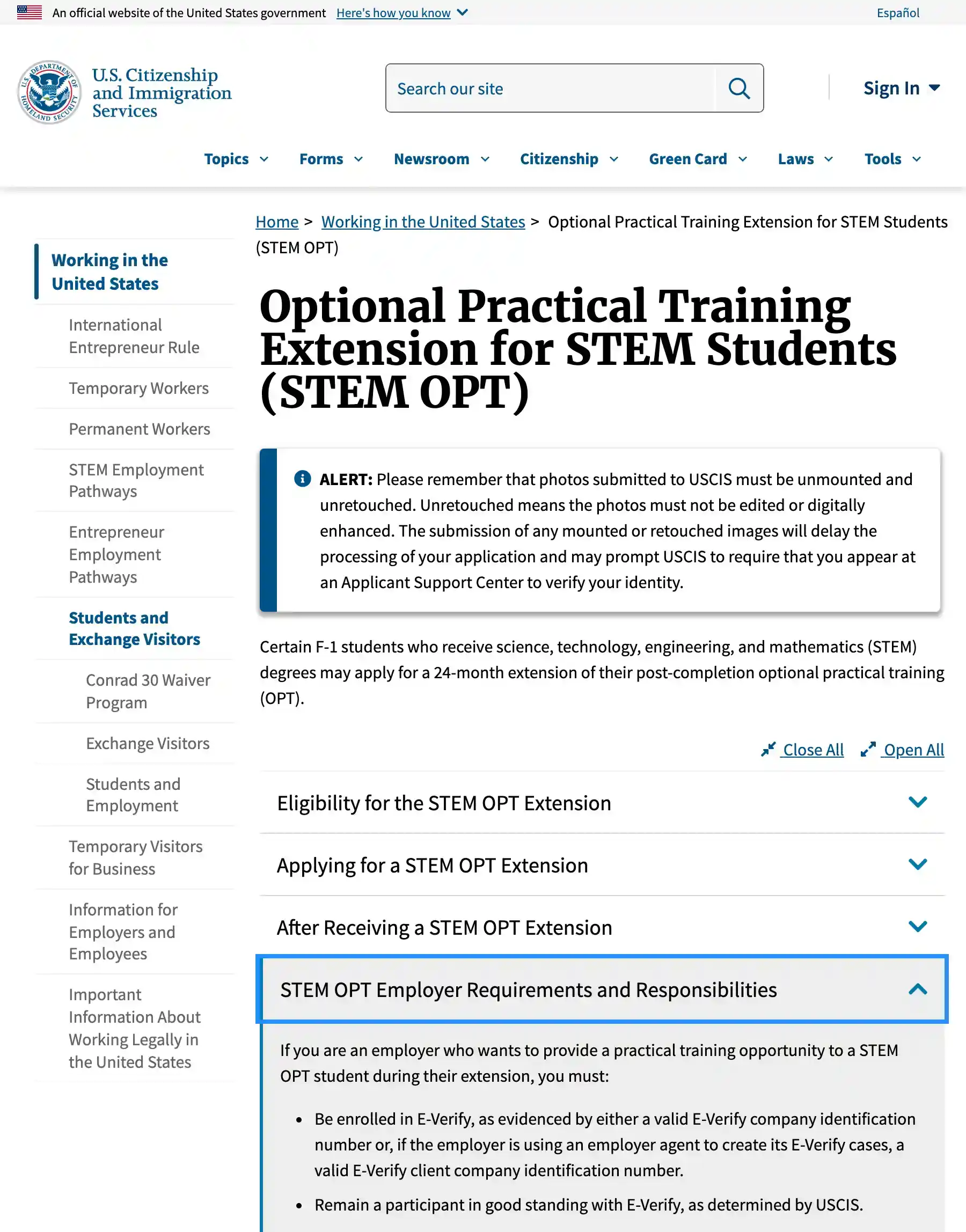
STEM OPT adds a 24-month extension and two employer duties. The employer must stay enrolled in E-Verify in good standing and must sign Form I-983. The USCIS page lists no petition here either.
Why “now or in the future” is the hard part
The second half of the line is what trips up students. One asked: “Amazon asked if I need sponsorship, but I’m on regular OPT. Did I answer correctly?” A reply advised the student to “tell the truth now and see if they are willing to sponsor”.
Why would an employer care about the future? OPT lasts up to 12 months and STEM OPT adds 24, so the permission ends. One applicant whose offer was rescinded wrote that the employer’s position was “that OPT is temporary and I would eventually need sponsorship.” A laid-off STEM OPT applicant named recruiter screens as the main obstacle, where “many companies flag” the line.
| Wording in the posting | Usually points to | What it leaves open |
|---|---|---|
| “No sponsorship” or “no sponsorship available for this position” | No H-1B petition from this employer | Whether OPT, CPT or STEM OPT is accepted |
| “Must not require sponsorship now or in the future” | A later H-1B petition counts too | Whether a student on OPT is screened out |
| A client that “won’t sponsor directly” | Another company, such as a staffing agency, may file | Which company would be the petitioner |
| Nothing about sponsorship | Nothing is ruled out | Whether the employer would file |
People ask about these lines in the words they search for them: Google suggests “no sponsorship meaning” and “no sponsorship available for this position”. The staffing case is real. One H-1B poster described a contract role where the client “won’t sponsor directly” but the staffing agency could enter them in the H-1B lottery.
Where an employer’s petition does help a student
There is one place where an employer’s filing helps someone on OPT: the cap-gap extension. If the employer files a timely cap-subject Form I-129 asking for a change to H-1B status, SEVIS extends your F-1 status and any authorized OPT until April 1 of the following year.
| If | Then |
|---|---|
| The employer files a timely cap-subject Form I-129 requesting H-1B status | SEVIS extends your F-1 status and any authorized OPT until April 1 of the following year |
| The employer is cap-exempt | Its petition is not eligible for the cap-gap extension |
| The petition is denied, rejected, revoked or withdrawn | SEVIS restores your original end date |
An employer that files no petition has none to extend your status with. That is one benefit a “no sponsorship” employer cannot offer.
Is the question allowed?
In general, yes. The Justice Department’s Civil Rights Division says an employer may ask applicants whether they have the legal right to work and whether they will need sponsorship for an employment visa, though it calls avoiding the question a best practice. So expect the question on the form and answer it as it is written.
What the board shows
Most postings never use the line. Of the 83,858 postings the board had read, 7,027 say the employer will not sponsor, about 8 percent. Another 730 say it will, from 18 employers, and 76,101 state no stance, about 91 percent.
- 84,453US postings on the board
- 2,393employers
- 730say they sponsor, from 18 employers
- 76,101could sponsor: the posting does not rule it out
- Say they sponsor730
- Say they will not sponsor7,027
- Could sponsor: the posting does not rule it out76,101
- Not read yet595
Mynga Visa Jobs; stance is tagged from the posting text by rules plus a local model, so a fuller read may move postings, October 8, 2026. Counts of postings; refreshed on a schedule.
A posting that says nothing has not said no, so it could sponsor. The board tags each stance from the posting text with rules plus a local model, so a fuller read may move postings. I did not find a measured share of postings that add the line without meaning it, so I give none.
- Staff+ Software Engineer, Platform AccelerationAnthropicSan Francisco, CA
- Product Designer, GrowthAnthropicSan Francisco, CA
- Senior Product Manager (SaaS Agent Security)Palo Alto NetworksCA
- Domain ConsultantPalo Alto NetworksMA
- Early Career, Associate Product Manager (2027)FigmaSan Francisco, CA
- Senior Principal Software Engineer (AI Posture)Palo Alto NetworksCA
- Software Engineer Intern- Helios- 2027SingleStore
- Global Immigration and Compliance SpecialistSpaceXHawthorne, CA
- No posting here matches. The full list has the rest.


See the full list on Visa JobsMynga Visa Jobs, October 14, 2026. The full board has the rest, with the employer's own listing on each.
Visa Jobs lets members search US postings by role, pay and state, hide the ones that say they will not sponsor, and open the employer’s own listing.
The full research
Employers that say they sponsor
Every employer with an open US posting that says, in its own words, that it sponsors visas. The sentence behind each, the roles, the states, and where to read the posting.
- 18employers
- 730postings that say yes
- 7pages
$9one payment, and the file is yours
Look inside
All 2 pages, full size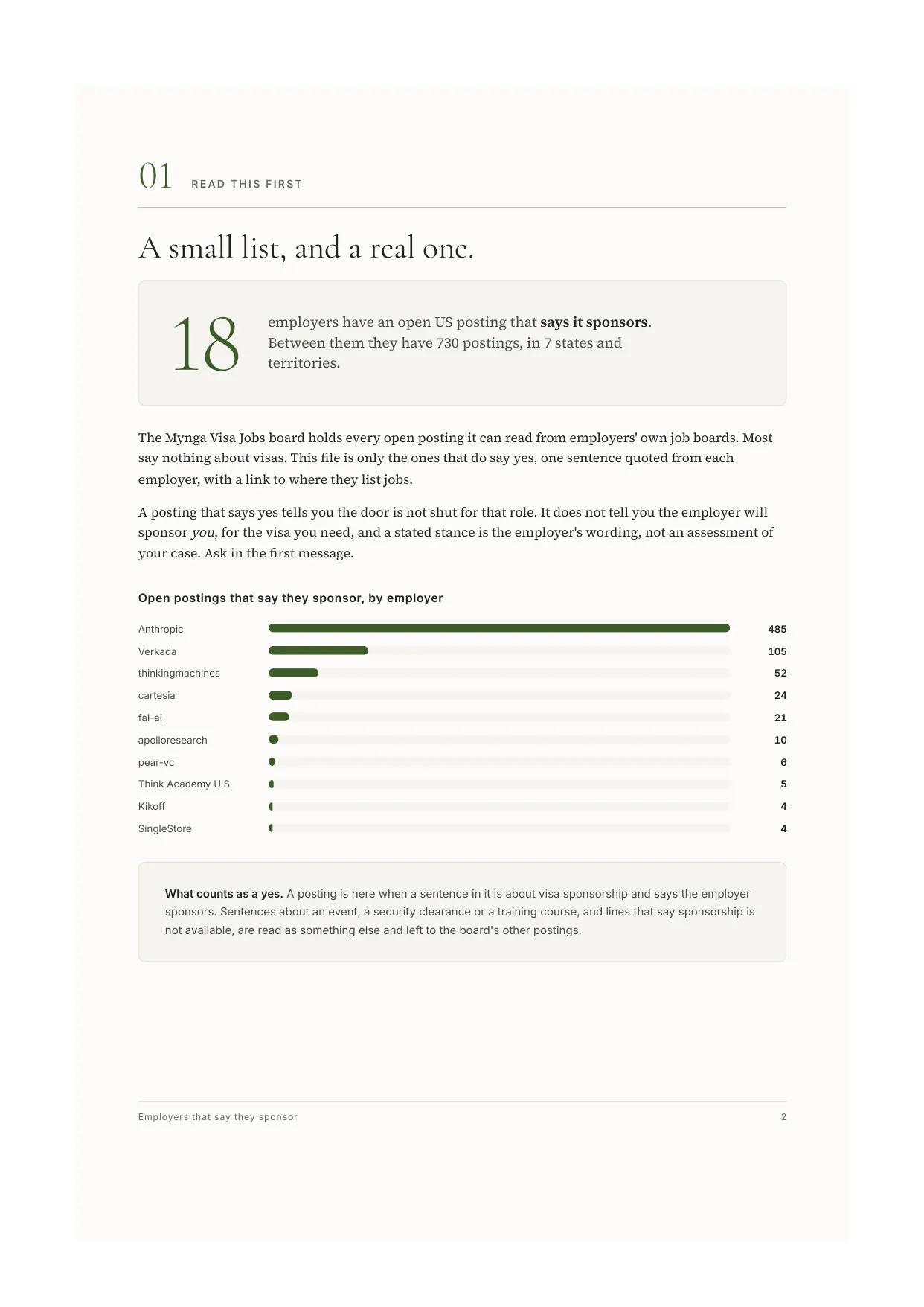
A decision order
- Read the exact words, because “now” and “in the future” are two different questions.
- Name your route: CPT, OPT or STEM OPT.
- Check whether the employer is enrolled in E-Verify if you are on STEM OPT, since the extension requires it.
- Ask the recruiter in plain words whether OPT or CPT counts for this role.
- Answer the form’s question as it is written and tell the truth, even when the true answer is “yes, later”.
Verdict
A petition is what the government calls employer sponsorship for an H-1B, and the CPT, OPT and STEM OPT pages list none. The posting’s words are the employer’s, so ask about work authorization before you skip a role. The board’s classification puts about 8 percent of postings at no and about 91 percent at silent.
Sources:USCIS - H-1B Specialty Occupations, USCIS - STEM OPT extension, USCIS - Optional Practical Training for F-1 students, Study in the States (SEVP) - F-1 Optional Practical Training, Study in the States (SEVP) - F-1 Curricular Practical Training, Study in the States (SEVP) - F-1 cap-gap extension, U.S. Department of Justice, Civil Rights Division - IER frequently asked questions, Mynga Visa Jobs (our own product), r/f1visa - If an internship posting says candidates must not require sponsorship now or in the future, r/f1visa - Amazon asked if I need sponsorship, but I'm on regular OPT, r/f1visa - Offer rescinded days before start over STEM OPT/sponsorship question, r/f1visa - Laid off on STEM OPT, what options do I have, r/h1b - Cap exempt, no sponsorship.
US jobs that tell you if they sponsor.
- Every posting states its visa stance
- Filter by role, visa and state
- Links to the employer's own listing
$8a month, cancel any time
See Visa JobsJoin Visa Radar on Discord
A free community for people moving to the US on a J-1, F-1/OPT or work visa.
Free when you join
- A job post every day
- Answers to your visa questions
- Wins from people on the same path
Responses
Keep reading
These industries employ the most immigrants
Professional and administrative services employ the most immigrants in the United States, while agriculture and construction have the highest share. Here is the sector and industry breakdown, and where graduates on F-1, OPT or J-1 will find the most company.

How to check which employers actually sponsor H-1B
A posting that says it will sponsor is not a filing record. Check the USCIS employer data, the Labor Department filings, the debarment list and the posting itself, in that order.

How to find US employers open to visa holders
Sponsor lists show who filed in the past. The J-1 sponsor directory, USCIS and Department of Labor data and the posting itself each answer a different question. Here is what each can and cannot say.