Cap-exempt H-1B employers: who qualifies and what changed in 2026
Universities, their affiliated nonprofits and research organizations can file H-1B petitions outside the 65,000 cap. Here is who counts, what the 2026 fee news says about them, and which dates are still open.

A cap-exempt H-1B employer can file a petition without a place in the 65,000 regular-cap lottery, and the group is narrow: universities, nonprofits tied to them, and nonprofit or government research organizations. A proposed $103,265 fee for cap-subject petitions would skip cap-exempt ones. It is a proposal only, and comments closed on 24 September 2026.
- 65,000Regular annual cap
- 20,000Extra for US master's or higher
- $103,265Proposed fee, cap-subject only
- $100,000Proclamation payment, new petitions
Who counts as a cap-exempt employer
The statute lists employers, not jobs. That is the first thing to know. A worker is outside the cap when employed, or offered a job, at an institution of higher education or a related or affiliated nonprofit, or at a nonprofit or governmental research organization. The regulation then defines each term, which is where most of the real questions about a particular employer get decided.
| Employer type | Qualifies when |
|---|---|
| Institution of higher education | It meets section 101(a) of the Higher Education Act of 1965 |
| Related or affiliated nonprofit | It meets any one of four affiliation tests |
| Nonprofit research organization | Basic or applied research is a fundamental activity |
| Governmental research organization | A federal, state or local body for which research is a fundamental activity |
How a nonprofit becomes affiliated
Any one of four tests is enough. The fourth adds a condition, because a written agreement alone does not do it: a fundamental activity of the nonprofit must also directly contribute to the research or education mission of the institution it is tied to.
| Test | What it requires |
|---|---|
| Shared control | The same board or federation owns or controls both organizations |
| Operated by | An institution of higher education operates the nonprofit |
| Attached | The nonprofit is a member, branch, cooperative or subsidiary of the institution |
| Written agreement | A formal affiliation agreement sets up an active working relationship for research or education, and the nonprofit’s fundamental activity feeds the institution’s mission |
What the 2024 rule changed
The final rule published on 18 December 2024 took effect on 17 January 2025. It replaced “primarily engaged” and “primary mission” with “fundamental activity”, so a research organization no longer has to show that research is its main purpose. It also recognized that a worker not directly employed by a qualifying organization can count if half or more of their time goes to essential work supporting its fundamental purposes. The regulation adds that work at a qualifying entity may include telework.
How many fee-exempt petitions come from these employers
USCIS counted 456,725 petitions filed in fiscal year 2025, and 163,051 carried at least one exemption from the ACWIA fee. That list is wider than the cap exemption, since it also covers second extensions, amendments, schools below college level and clinical training, and one petition can sit in several rows. The three rows that match cap-exempt employer types are charted below.
- Institution of higher education26,949
- Nonprofit related or affiliated24,073
- Nonprofit or government research7,560
USCIS FY2025 H-1B annual report, February 11, 2026. Counts of petitions; refreshed on a schedule.
The 2026 news in order
Two payments are in the news. They work differently. The $100,000 payment comes from a presidential proclamation and applies to new H-1B petitions submitted after 21 September 2025. The proclamation text does not mention cap-exempt, nonprofit, university or research employers, and the USCIS FAQ does not address them either, so neither page settles how the payment treats a cap-exempt petition.
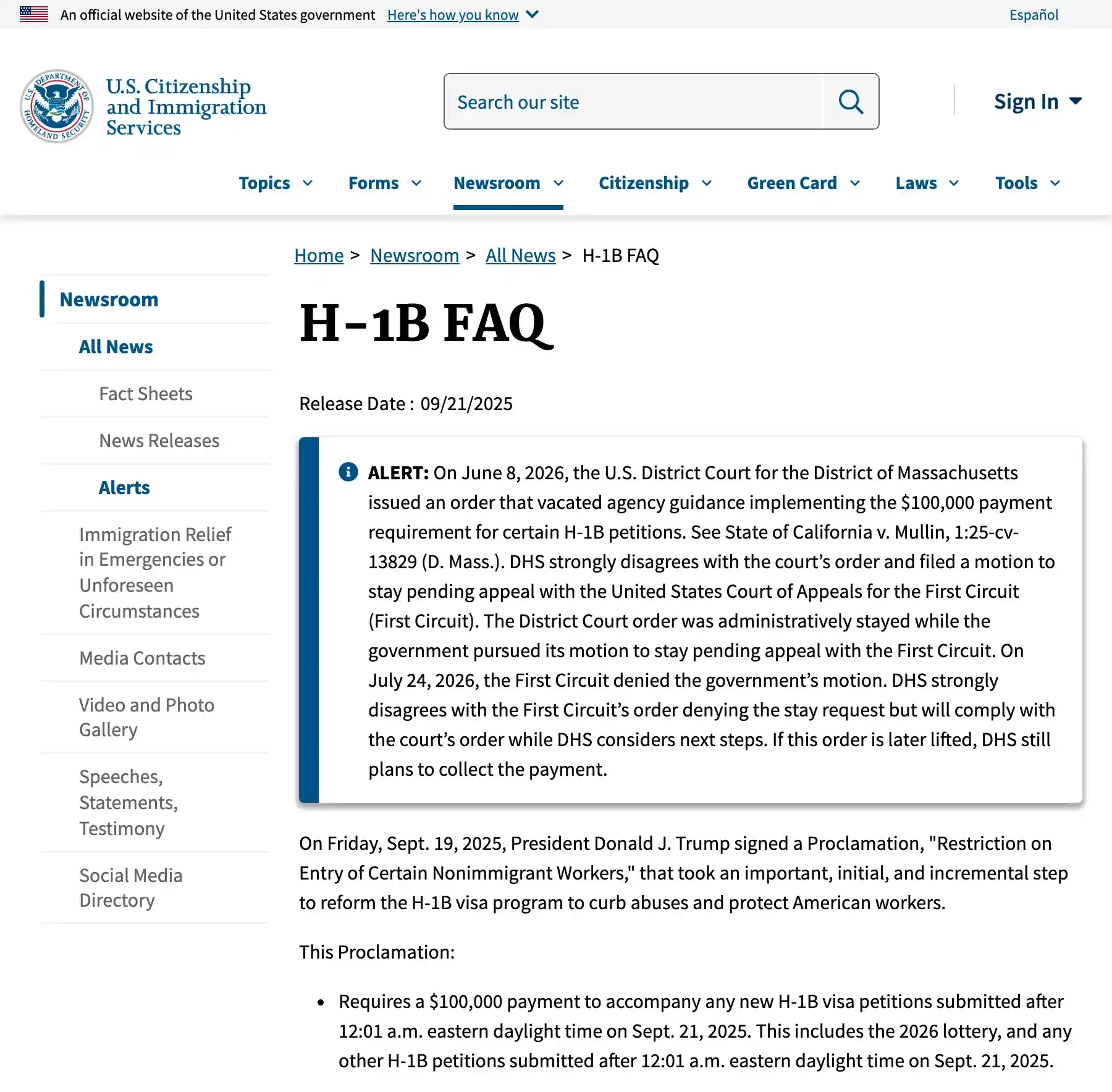
The $103,265 fee is a separate proposal for cap-subject petitions. DHS proposes to leave cap-exempt petitions out, because many of those workers are employed by research organizations and educational institutions, and the proposal states no effective date.
| Date | Event | Status |
|---|---|---|
| 18 Dec 2024 | Final rule on H-1B modernization published | Effective 17 Jan 2025 |
| 21 Sep 2025 | $100,000 payment starts for new petitions | Extended by proclamation |
| 8 Jun 2026 | District court vacates agency guidance on the payment | First Circuit denied the government’s motion on 24 Jul 2026 |
| 25 Aug 2026 | $103,265 fee proposal published | Comments closed 24 Sep 2026 |
| 11 Sep 2026 | Proposal to end the 60-day grace period published | Comments due 10 Nov 2026 |
| 18 Sep 2026 | Proclamation extended 12 months | Effective 21 Sep 2026 |
DHS estimated about $8.8 billion a year from the proposed fee, based on 85,000 petitions a year. On the court order, DHS says it will comply while it considers next steps, and it plans to collect the payment if the order is later lifted.
Does a move between employers bring the lottery back?
The answer turns on how the cap-exempt job ends and whether the person was counted before. Someone who leaves cap-exempt employment without a new cap-exempt petition is subject to the cap, unless already counted within the six-year period. A cap-subject job held alongside a cap-exempt one does not trigger the cap, when the cap-exempt job is expected to continue and both can reasonably be done at once.
| Situation | Cap applies? |
|---|---|
| New employer files a cap-exempt petition | No, the person stays cap-exempt |
| Cap-exempt job ends, no new cap-exempt petition, counted before within six years | No |
| Cap-exempt job ends, no new cap-exempt petition, never counted | Yes |
| Cap-subject job held alongside a continuing cap-exempt job | No, and its validity cannot exceed the cap-exempt validity |
| Cap-exempt job ends early while a concurrent cap-subject petition is pending | Yes, if never counted before and no other exemption applies |
What the grace-period proposal would change
The proposal published on 11 September 2026 would remove the rule behind the grace period of up to 60 days after employment ends, for H-1B and several other classes. Anyone whose cap-exempt job ends would be affected, and comments are due on 10 November 2026.
Where to check an employer
The USCIS H-1B Employer Data Hub covers fiscal years 2009 through 2026 (quarter 3) and can be searched by employer name, city, state, zip code and NAICS code. Employers appear by the last four digits of their tax identification, so similar names need a second look. Cap status is not among the listed search fields, so a university or research institute still has to be checked against the tests above.
Verdict
Cap-exempt status belongs to the type of employer, not the job title, and the four categories above set the boundary. The $103,265 proposal would skip these petitions but is not in force, and the $100,000 proclamation text names no carve-out for them. The grace-period proposal and the court order on the $100,000 payment are the next developments to watch.
Search US postings that state their sponsorship stance
The full research
Employers that say they sponsor
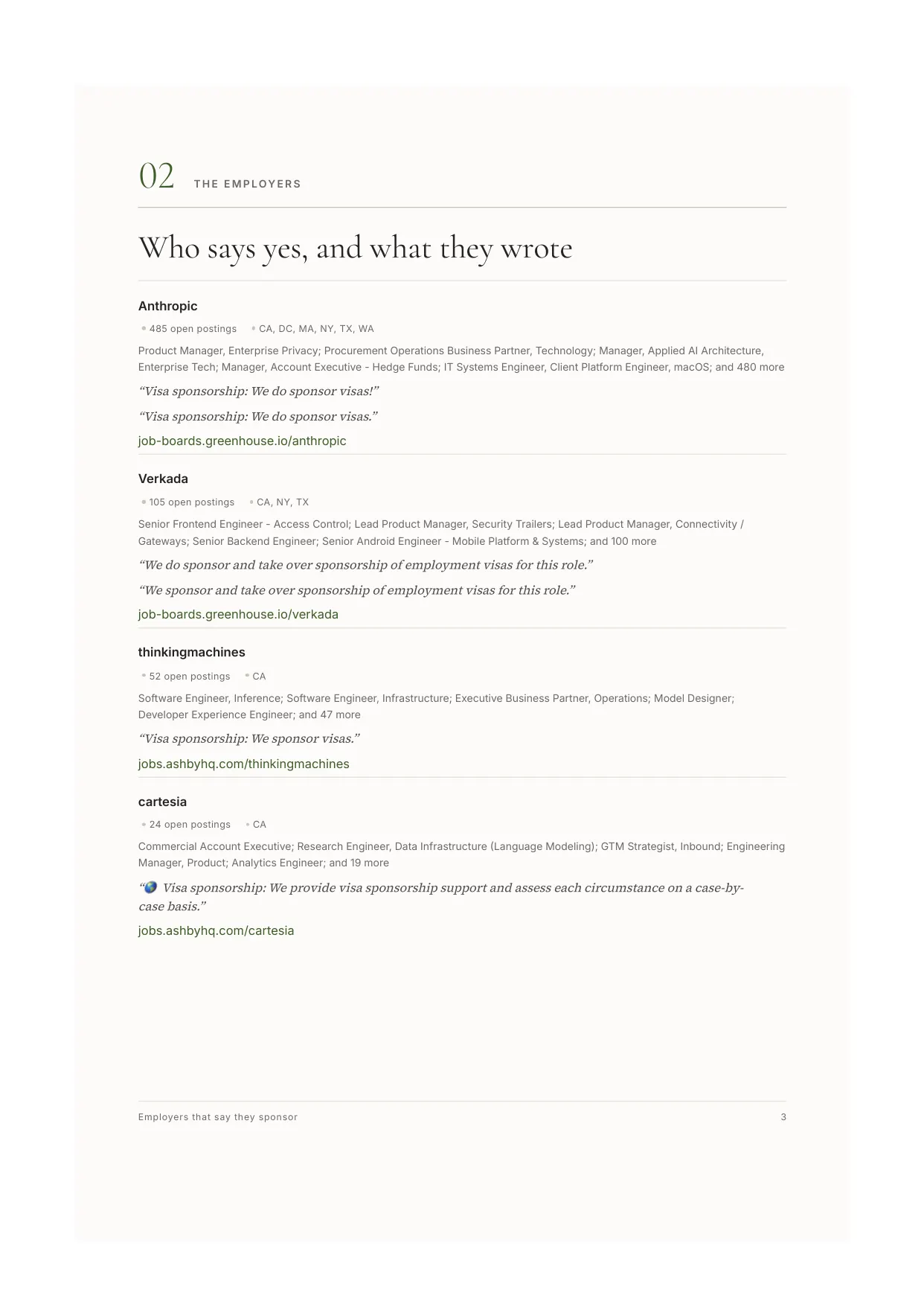
Every employer with an open US posting that says, in its own words, that it sponsors visas. The sentence behind each, the roles, the states, and where to read the posting.
- 18employers
- 730postings that say yes
- 7pages
$9one payment, and the file is yours
Look inside
All 2 pages, full size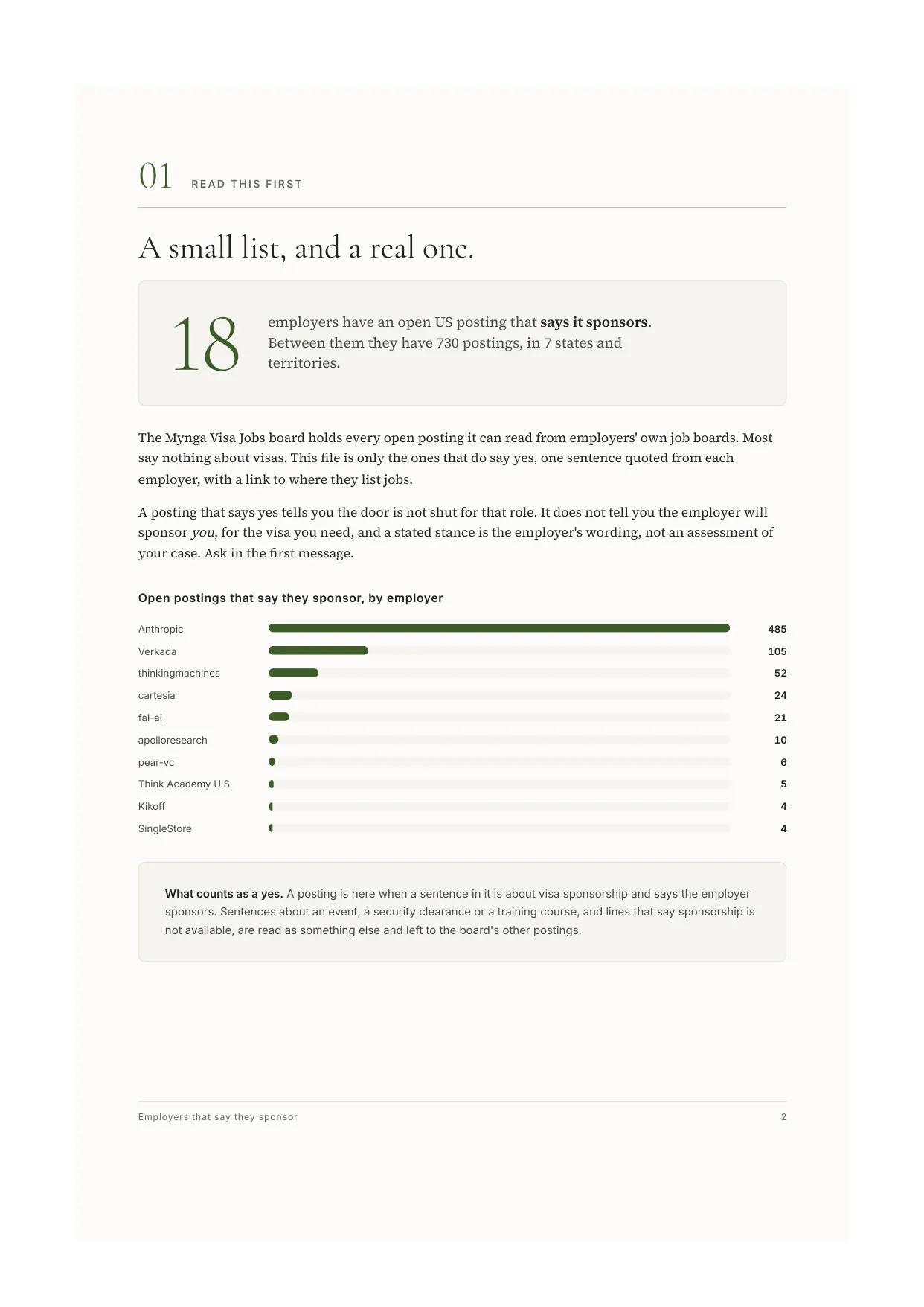
Sources:USCIS - H-1B Cap Season, 8 U.S.C. 1184(g)(5) - Cornell Legal Information Institute, 8 CFR 214.2(h) - Electronic Code of Federal Regulations, Federal Register - Modernizing H-1B Requirements (89 FR 103054), Federal Register - Fee for Certain H-1B Petitions (91 FR 54817), USCIS - DHS Proposes Additional H-1B Fee, White House - Restriction on Entry of Certain Nonimmigrant Workers, USCIS - H-1B FAQ on the $100,000 payment, Federal Register - Eliminating the Discretionary 60-Day Grace Period (91 FR 57807), USCIS - Fiscal Year 2025: H-1B Petitions, Annual Report to Congress, USCIS - H-1B Employer Data Hub.
US jobs that tell you if they sponsor.
- Every posting states its visa stance
- Filter by role, visa and state
- Links to the employer's own listing
$8a month, cancel any time
See Visa JobsJoin Visa Radar on Discord
A free community for people moving to the US on a J-1, F-1/OPT or work visa.
Free when you join
- A job post every day
- Answers to your visa questions
- Wins from people on the same path
Responses
Keep reading
These industries employ the most immigrants
Professional and administrative services employ the most immigrants in the United States, while agriculture and construction have the highest share. Here is the sector and industry breakdown, and where graduates on F-1, OPT or J-1 will find the most company.
How to check which employers actually sponsor H-1B
A posting that says it will sponsor is not a filing record. Check the USCIS employer data, the Labor Department filings, the debarment list and the posting itself, in that order.
What no sponsorship in a job post means, and what it does not
A job post that says no sponsorship usually means no H-1B petition. It does not by itself rule out OPT, CPT or STEM OPT. Here is what each route asks of the employer.