What a company actually has to do to host a J-1 intern
A J-1 host helps build the placement plan, provides supervision and follows programme rules. Here are the documented duties, applicant fees and current admission-rule caveat.

We are not set up to sponsor visas. For a company considering a J-1 intern, the first useful step is to distinguish hosting a placement from administering the exchange programme.
The State Department tells employers to choose a programme and then contact a designated sponsor. That sponsor administers the exchange. The host provides the workplace and training described in the placement plan.
5host duties shown
- 5 you
- 12 the sponsor
- 1 intern
- Sign the DS-7002 placement plan62.22(h)(1)
- Supervise on site, and mentor62.22(f)(2)(ii)
- Tell the sponsor when anything changes62.22(h)(2)
- Follow occupational health and safety laws62.22(h)(3)
- Follow sponsor rules, including evaluations62.22(h)(4)
13 selected sponsor and intern duties
- Screen and select the internsponsor62.22(f)(1)(i)
- Verify her Englishsponsor62.22(d)(1)
- Verify she is a student or recent graduatesponsor62.22(d)(3)
- Interview her, on the recordsponsor62.22(f)(3)
- Check your EIN, address and phonesponsor62.22(g)(3)
- Check your workers' compensation coversponsor62.22(g)(3)(iii)
- Visit your site, if you are small and new to themsponsor62.22(g)(4)
- Draft the placement plan with yousponsor62.22(i)
- Issue the DS-2019sponsor62.22(m)
- Confirm she can support herselfsponsor62.22(e)(2)
- Enforce the insurance minimumssponsor62.14
- Keep required records for at least three years after completionsponsor62.22(f)(4)
- Maintain the required insurance coverageintern62.14
Check the sponsor and the placement
The designated sponsor issues Form DS-2019. For an internship, it must first secure the placement and obtain a completed DS-7002 with all required signatures.[1]
Check the organisation and its designated category in the State Department’s sponsor directory. Ask the sponsor to explain its requirements for your particular placement before making commitments.
The placement plan needs your signature
Form DS-7002, the Training/Internship Placement Plan, describes what the intern will learn and do. It must state the goals, skills to be taught, supervision and evaluation methods. An intern’s plan also identifies their role and specific tasks.[1]
The sponsor must obtain all required signatures before issuing DS-2019. The placement plan is not necessarily the only document you sign: section 62.22(l) also requires signed evaluations. For programmes longer than six months, at least midpoint and concluding evaluations are required; for shorter programmes, at least a concluding evaluation.[1]
Four duties in subsection (h), with further requirements elsewhere
Section 62.22(h) requires the host to:[1]
- Sign the completed DS-7002, confirming that the placement fits the intern’s objectives, skills and experience.
- Notify the sponsor promptly of concerns or changes to the plan, and immediately in an emergency involving the participant.
- Follow federal, state and local occupational health and safety laws.
- Follow the sponsor’s programme rules, including mandatory evaluations.
Other parts of the same section require adequate resources and experienced staff, continuous on-site supervision and mentoring, and structured learning activities. The placement must not displace American workers or serve to fill a labour need.[1]
Those additional requirements matter. The four items in subsection (h) are not a complete checklist of everything a host must arrange.
What the placement cannot be
The regulation excludes the following kinds of placement or involvement.[1]
Unskilled or casual labour
The programme teaches a field. It does not staff a shift.
Child care or elder care
Excluded outright, paid or unpaid.
Patient care or contact
Including nursing, therapy and counselling.
Over 20% clerical work
Measured against the plan you sign, not against the job ad.
Anything through a staffing agency
A sponsor may not contract with one at all.
The State Department’s Intern programme page also explains the exclusions and lists the permitted occupational categories. Category-specific requirements may add to this summary; for example, hospitality and tourism programmes lasting six months or longer require at least three departmental or functional rotations.[1]
What the sponsor must check
Section 62.22(g)(3) requires:[1]
- Your EIN.
- Third-party verification of your telephone number, address and professional activities. The regulation gives examples such as advertising, brochures, a website or past participants.
- Workers’ compensation coverage, an equivalent, or evidence of an applicable state exemption.
A sponsor must conduct a site visit when a host has not previously participated successfully in that sponsor’s training or internship programmes and has fewer than 25 employees or less than $3 million in annual revenue. Academic institutions and federal, state and local government offices are excluded from this requirement.[1]
The visit checks the host’s ability and resources to provide structured learning and its understanding of programme obligations. It is part of the sponsor’s assessment, not an approval to assume in advance.
Hours, duration, compensation and location
The exchange regulation requires at least 32 hours a week and caps an internship at 12 months, subject to the sponsor’s authorised designation.[1]
Section 62.16 permits compensation for employment that is part of the exchange programme. It does not decide whether a particular internship may legally be unpaid. Resolve compensation requirements for the actual role and location before agreeing to the plan.[2]
Section 62.22 does not state a remote-work percentage, but it does require on-site supervision. That absence is not permission for remote work. Ask the sponsor to confirm the proposed work arrangement against current programme requirements.[1]
Payroll needs an individual check
The IRS describes a Social Security and Medicare tax exemption for qualifying nonresident J-1 visitors performing authorised work connected to the purpose of their visa. Certain non-student J-1 visitors present for less than two calendar years are generally nonresident aliens, but the visa label alone does not settle tax residency.[3]
This exemption does not extend to J-2 status, unrelated or unauthorised employment, a change to a non-exempt status, or someone who becomes a resident alien. Ask payroll to assess the participant’s circumstances using the IRS guidance.
Applicant fees do not describe the full cost of hosting
The standard I-901 J-visa fee is $220, with category-specific exceptions.[4] The standard non-petition-based visa application fee is $185 per person, with exemptions including official U.S. Government sponsored J exchanges. A separate reciprocal issuance fee may apply.[5]
Those are applicant fee entries. They do not establish that hosting has no other costs or that someone has agreed to pay every charge. Ask the sponsor for written programme fees and payment responsibilities. Section 62.10(b) requires sponsors to give participants itemised fees and likely costs before arrival.[2]
The September admission rule is subject to a court postponement
Reviewed 22 September 2026. A DHS final rule published on 17 July would replace duration-of-status admission with fixed periods and named 15 September as its effective date. A 14 September federal court order postponed that date nationwide. The relief is preliminary, not permanent repeal.[6]
Do not assume that the dates on DS-7002 automatically become the participant’s lawful admission period. Coordinate date changes with the sponsor and confirm current travel and status instructions before the placement begins.
Starting a conversation about a placement
A useful first discussion covers the supervisor, proposed tasks and learning goals, programme dates, and the sponsor’s host-verification requirements. The sponsor must assess both the applicant and the placement; this article is not an eligibility or acceptance decision.[1]
The applicant’s guide explains the corresponding documents, fees and insurance requirements. You can reach me through the contact page.
This is a general guide, not individual immigration or tax advice. The cited sources and checked dates let your sponsor, payroll team or counsel review the relevant requirement directly.
The full research
Who will actually sponsor you
Every organisation that can sponsor a J-1 Intern or Trainee, what each one will and will not do for you, and what it costs. For any field, from any country.
- 114sponsors listed
- 29written to
- 15answered in full
- 18pages
$9one payment, and the file is yours
Sponsor quotes are being rechecked before this file goes on sale. Ask me about this file.
Look inside
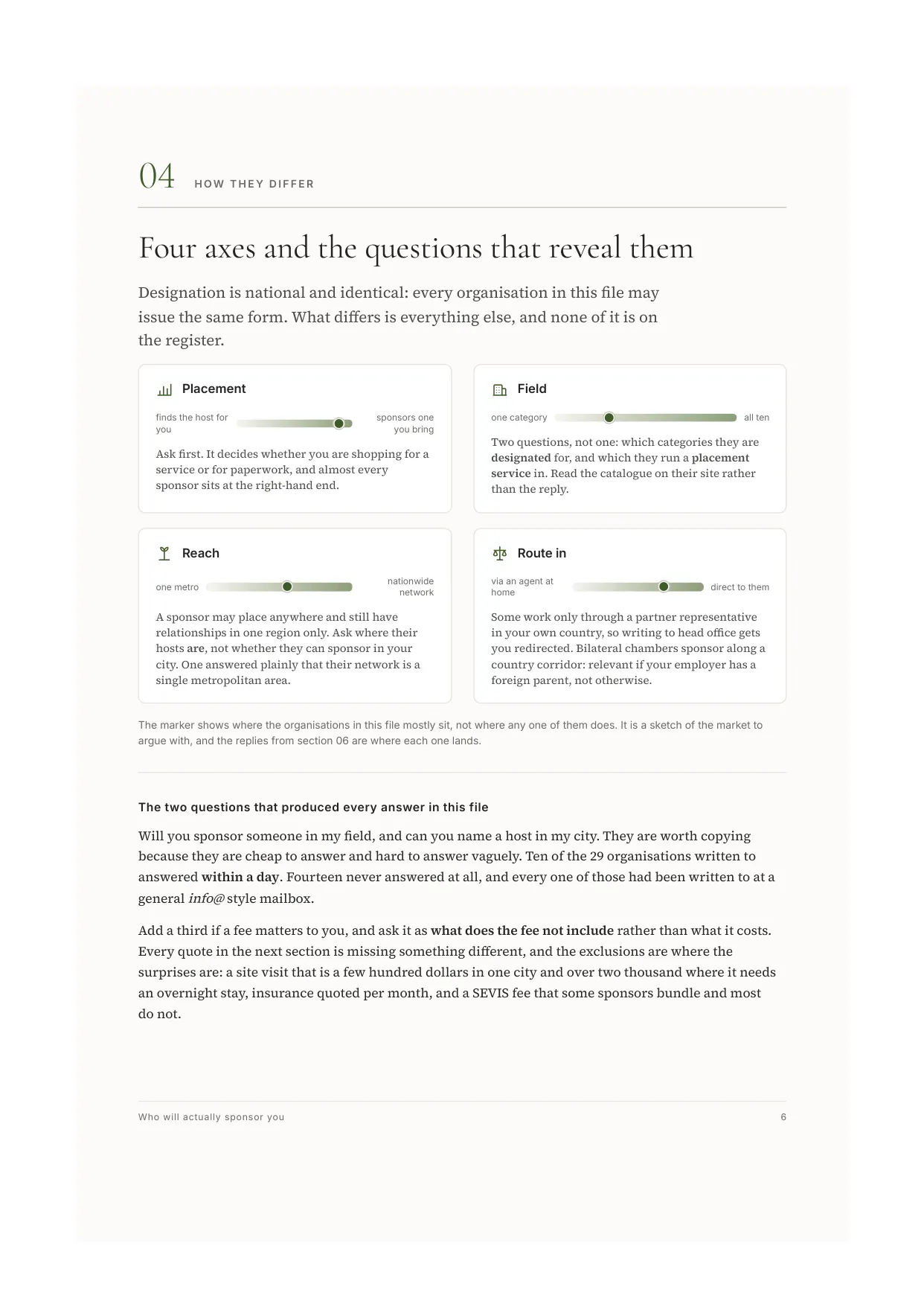
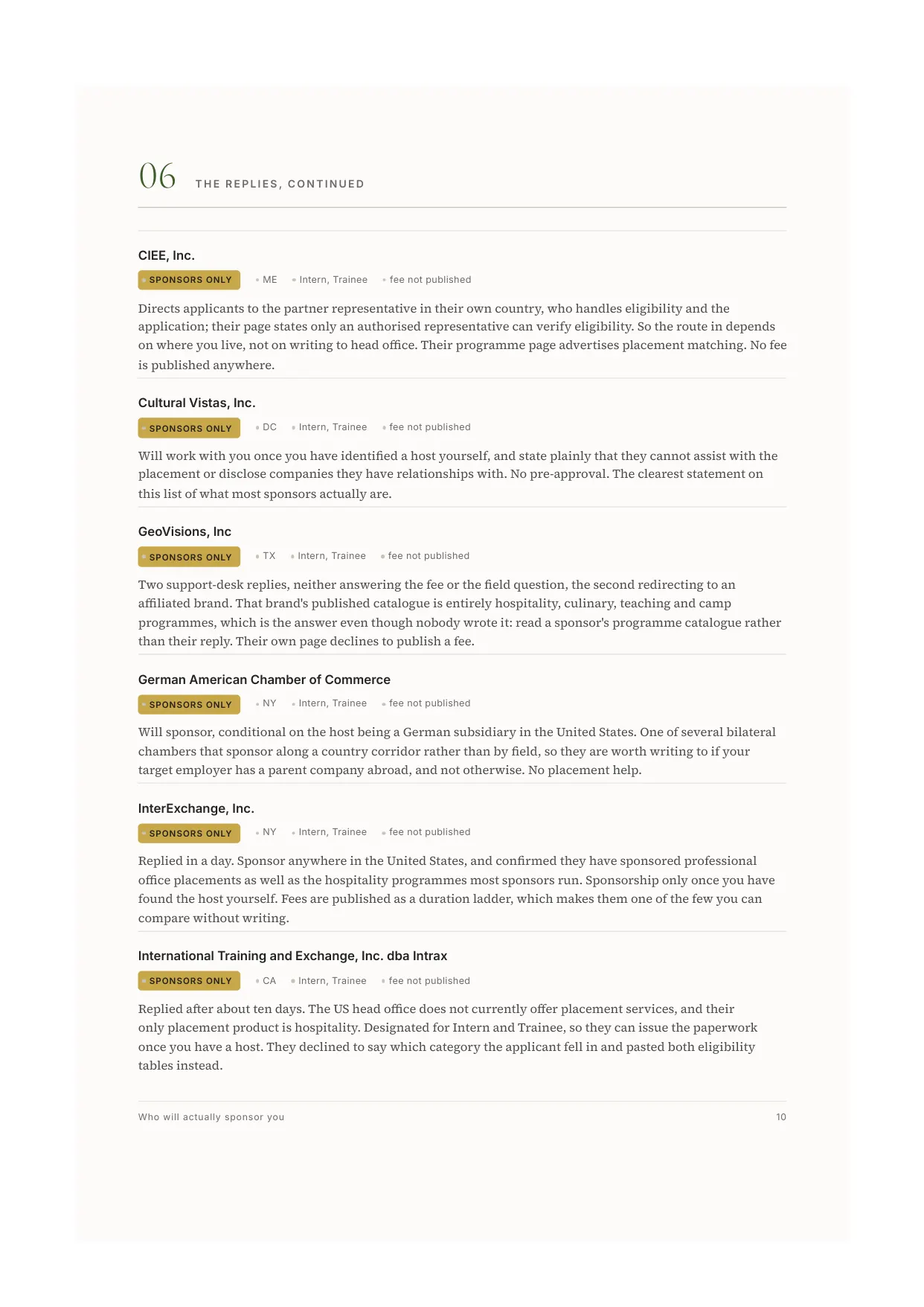
All 3 pages, full size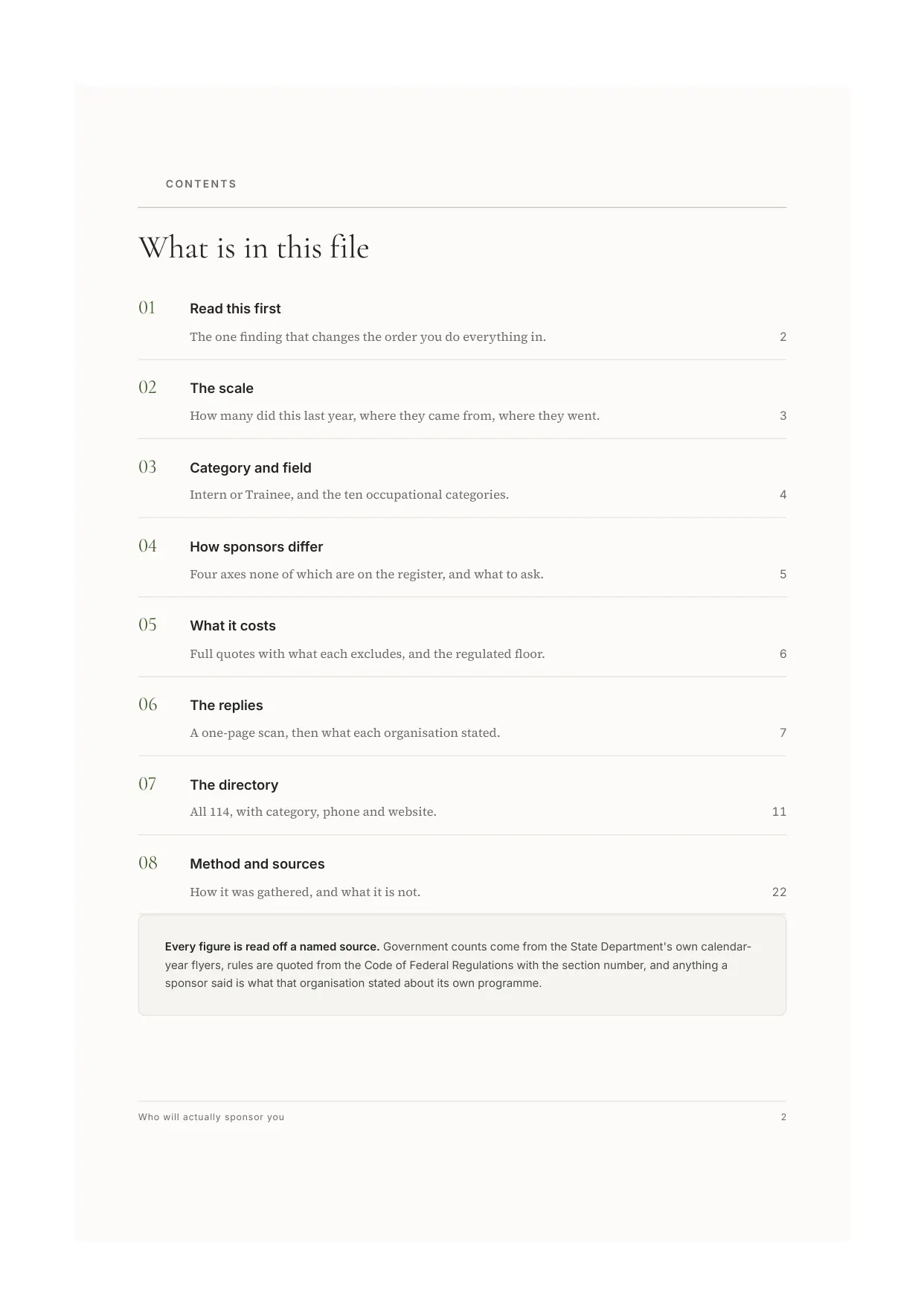
Sources10 sources, cited 23 times in this post
- ↑22 CFR 62.22 - Trainees and internsSection 62.22(h) lists four host obligations; additional requirements appear elsewhere in the section. Sections (e) and (i) require a secured placement and completed, signed DS-7002 before DS-2019 issuance. Section (f) requires at least 32 hours weekly, resources, on-site supervision, structured learning and no displacement of American workers. Section (g)(3)-(4) covers EIN, third-party business verification, workers compensation and site visits for new hosts with fewer than 25 employees or less than $3 million revenue, excluding academic institutions and government offices. Section (j) excludes specified roles, staffing-agency involvement and more than 20 per cent clerical work. Section (k) caps internships at 12 months. Section (l) requires signed concluding evaluations, plus midpoint evaluations for programmes over six months. This section sets no remote-work percentage.CheckedSep 22, 2026 · cited 12 times
- ↑22 CFR Part 62 - Exchange Visitor ProgramSections 62.10(b)(5)-(7) require advance disclosure of itemised fees and other costs. Section 62.12 governs sponsor issuance of DS-2019. Section 62.14 requires programme-period insurance, including $100,000 medical benefits, $25,000 repatriation, $50,000 evacuation, a $500 maximum deductible per accident or illness and up to 25% co-insurance; it provides several acceptable coverage arrangements and requires termination for willful noncompliance. Section 62.16 permits programme employment compensation and makes unauthorised employment subject to termination.CheckedSep 22, 2026 · cited 2 times
- ↑IRS - Social Security and Medicare taxes for foreign teachers, researchers and other professionalsCertain non-student J-1 visitors present for less than two calendar years are generally nonresident aliens. The exemption requires nonresident status and authorised services connected to the visa purpose. It does not apply to J-2 status, unrelated or unauthorised employment, non-exempt changes of status or visitors who become resident aliens. Payroll must determine the individual treatment.CheckedSep 22, 2026 · cited 2 times
- ↑ICE - I-901 SEVIS FeeThe fee table lists J visa applicants (full payment) at $220, special J categories at $35, government visitors at $0, and F or M applicants at $350. This is the SEVIS fee, not a complete visa or travel budget.CheckedSep 22, 2026
- ↑22 CFR 22.1 - Schedule of Fees for Consular ServicesItem 21(a) lists the non-petition-based nonimmigrant visa application fee, except E category, at $185 per person. Item 22(b) exempts official U.S. Government sponsored educational and cultural J exchanges. Item 23 lists the issuance fee as reciprocal. These applicant fee entries do not establish every possible cost of hosting.CheckedSep 22, 2026
- ↑U.S. District Court, D. Mass. - 14 September 2026 order, No. 26-13799-FDS, Doc. 50 (copy hosted by plaintiff NAFSA)Pages 46-48 address nationwide relief. The court grants the motion to postpone the effective date of the final rule under 5 U.S.C. 705; vacatur and other relief are denied without prejudice. Signed and filed 14 September 2026. This is preliminary relief, not permanent repeal.CheckedSep 22, 2026
- ↑U.S. Department of State (BridgeUSA) - Employer OpportunitiesState instructs prospective employers to choose a programme and then contact a designated sponsor. It describes sponsors as the organisations administering the programme and connecting hosts with participants. This short page does not establish that a host has no other obligations.CheckedSep 22, 2026
- ↑U.S. Department of State (BridgeUSA) - Intern programmeThe page lists intern eligibility and occupational categories, excludes unskilled labour, care roles, patient contact and more than 20 percent clerical or office support work, and describes host duties including resources, continuous on-site supervision, structured learning and evaluations.CheckedSep 22, 2026
- ↑DHS final rule of 17 July 2026 - admission periods (effective date postponed)The published final rule set a 15 September 2026 effective date and would replace duration-of-status admission with fixed periods for F and J visitors, generally programme length capped at four years. This document establishes what DHS published, not that the rule took effect. The 14 September court order postpones its effective date.CheckedSep 22, 2026
- ↑U.S. Department of State - designated sponsor searchThe directory supports searches by programme, sponsor name and state and displays designated sponsors with contact details. Official sponsor addresses do not restrict where they may place participants.CheckedSep 22, 2026