What you actually need for a J-1 visa, in the order you need it
The J-1 application chain, its standard SEVIS and visa application fees, insurance requirements, and the court order postponing the September 2026 admission change.
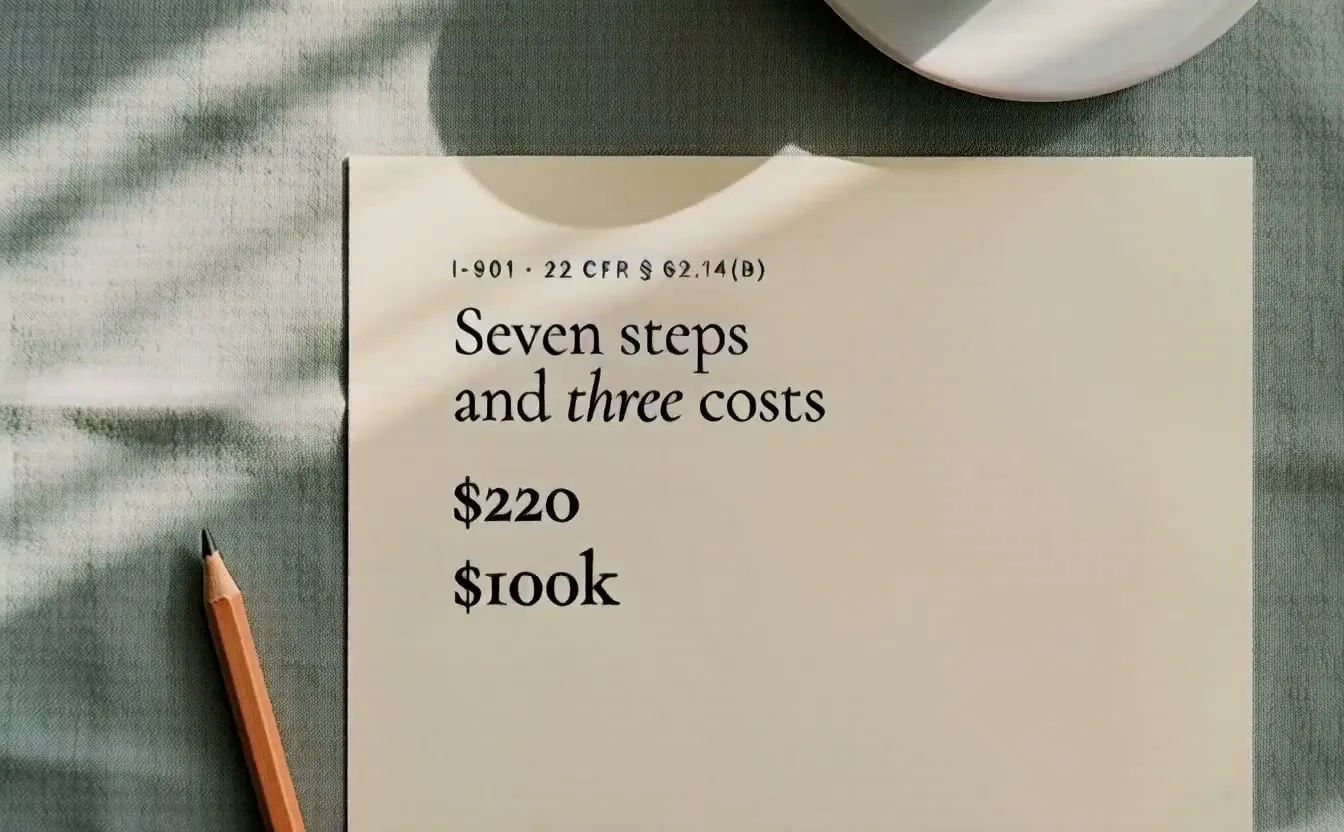
What do you need for a J-1 visa, and what has to happen first? Start with programme acceptance and the sponsor’s documents, then follow the instructions of the consulate where you apply. The order of local application and payment steps can vary.[1]
The diagram shows that chain and two standard fees. It is not a complete budget: sponsor fees, insurance, travel and any other applicable charges need separate confirmation.
01 You
Find a designated sponsor, and get accepted
Choose the appropriate exchange category. A job offer alone is not programme acceptance.
Confirm sponsor fees and timing
02 Your sponsor
They issue your Form DS-2019
It carries your SEVIS ID. Interns and trainees also need the signed DS-7002 placement plan.
Sponsor charges are separate
03 Homeland Security
Pay the I-901 SEVIS fee
Paid against your SEVIS ID. Not to the sponsor, and not at the embassy.
Standard J fee: $220Some J categories pay less or nothing
04 Back to you
File Form DS-160 and pay the application fee
Follow your consulate's application and payment order. The application fee is non-refundable.
Standard application fee: $185These two standard fees total $405
05 The consulate
The interview
A consular officer decides whether you qualify. Payment does not guarantee a visa.
Follow local interview instructionsProgramme and other charges excluded
06 The consulate
The issuance fee, if your nationality is charged
Check the State Department's published reciprocity schedule for your nationality and visa class.
Pay the listed fee, if applicableThis charge varies by nationality
07 The border
Arrive, at most 30 days before your start date
A visa is not an entry. A second person decides, at the border.
Check entry requirements for your routeThis diagram is not a complete budget
- You act. Nothing is issued yet
- A document arrives
- Money leaves your hand
- Somebody decides, and no is real
Programme conditions and the current admission note
Insurance during the programme
- Medical, per accident or illness
- $100,000
- Repatriation of remains
- $25,000
- Medical evacuation
- $50,000
- Deductible, at most
- $500
Only the work in your programme
Unauthorised employment is a programme-status violation subject to termination under section 62.16.
September admission change postponed
A 14 September court order postponed the fixed-period rule. Check your I-94 and current sponsor instructions. Reviewed 22 September 2026; see the order below.
Start with a designated sponsor
A designated sponsor administers the exchange programme. The State Department lists programmes including Intern, Au Pair and Research Scholar; eligibility and placement rules depend on the category.
After acceptance, the sponsor issues Form DS-2019 and registers the participant in SEVIS.[1] The form carries the SEVIS ID needed for the I-901 payment. Interns and trainees also need a completed DS-7002 placement plan.[1]
Use the State Department’s designated sponsor directory to check an organisation and find its contact details. Then request its current itemised fees, payment schedule and refund terms. Sponsors must disclose fees and likely costs before arrival under section 62.10(b).[2] There is no reason to treat the two government fees below as the price of the whole programme.
Two standard fees, plus a nationality-specific issuance fee
The I-901 SEVIS fee is $220 at the full J-visa rate. The ICE table also lists $35 for special J categories and $0 for government visitors. F and M applicants have a different full rate, $350.[3] Check the applicable category before paying.
The standard visa application fee is $185 per person. Official U.S. Government sponsored educational and cultural J exchanges have an exemption.[4] The State Department calls the application fee non-refundable; payment does not guarantee a visa.[1]
An issuance fee may also apply after approval. The fee schedule calls it reciprocal, so there is no single amount for every nationality.[4] Amounts are published in the State Department’s country reciprocity schedules, linked from its exchange visitor visa page. Check your nationality and visa class before budgeting. Confirm any other applicable government charges with the consulate.
Insurance lasts for the programme
Insurance is an ongoing requirement during the programme dates recorded in SEVIS, including coverage for accompanying spouses and dependants.[2] Section 62.14 sets these amounts:
| Coverage | Required amount |
|---|---|
| Medical benefits, per accident or illness | At least $100,000 |
| Repatriation of remains | $25,000 |
| Medical evacuation to the home country | $50,000 |
| Deductible, per accident or illness | No more than $500 |
The same section permits co-insurance up to 25% of covered benefits per accident or illness. It also specifies acceptable coverage arrangements, including insurer ratings and alternatives; a price quote alone does not show a policy qualifies.[2]
Sponsors must terminate participation if they determine that the visitor or an accompanying spouse or dependant willfully fails to comply with the insurance requirement.[2]
Employment has its own limit: section 62.16 permits compensation for employment that is part of the programme. Unauthorised employment is a status violation subject to termination.[2]
The September admission change was postponed
Reviewed 22 September 2026. The DHS rule published on 17 July set 15 September as its effective date. It would replace duration-of-status admission with fixed periods, generally the programme length capped at four years.
But on 14 September 2026, the U.S. District Court for the District of Massachusetts postponed the rule’s effective date nationwide. The order grants preliminary relief under 5 U.S.C. 705; it does not permanently repeal the rule.[5]
The earlier version of this post described September 15 as an upcoming change. Do not use that date to assume your admission has switched to a fixed period. Check your own I-94 and confirm current instructions with your sponsor before travel or an extension. Later court action can change this position.
Two B-1/B-2 rules are not J-1 fees
The visa bond rule, which states an effective date of 3 August 2026, permits bonds up to $20,000 for covered B-1/B-2 visitors. Its scope is business and tourism visas, not J-1.[6]
The $750 expedited interview appointment service is also limited to B1/B2 applicants. The temporary rule specifies 1 July through 31 December 2026, limited posts and quantities, and appointments within ten business days.[7] It does not create a J-1 expedited appointment option.
For Vietnamese applicants: the Skills List is only one part of 212(e)
INA 212(e) identifies three grounds for the two-year foreign residence requirement:
- Programme funding, wholly or partly and directly or indirectly, by the U.S. government or the government of the country of nationality or last residence.
- A relevant country and field designation on the Skills List at admission or acquisition of J status.
- Graduate medical education or training.
Vietnam is absent from the revised list applicable from 9 December 2024. That notice also removes the Skills List basis for people whose countries were on an older list but are absent from the revised one.[8]
That finding does not remove the funding or medical-training grounds, decide every individual’s case, or establish a waiver. Check all applicable grounds with your sponsor or qualified counsel rather than treating nationality as the whole answer.[9]
How to use these sources
This is a source-backed guide, not an individual immigration assessment. The checked dates below show when the cited claims were reviewed. Fees, consular instructions and litigation can change; recheck the relevant source before acting.
The full research
Who will actually sponsor you
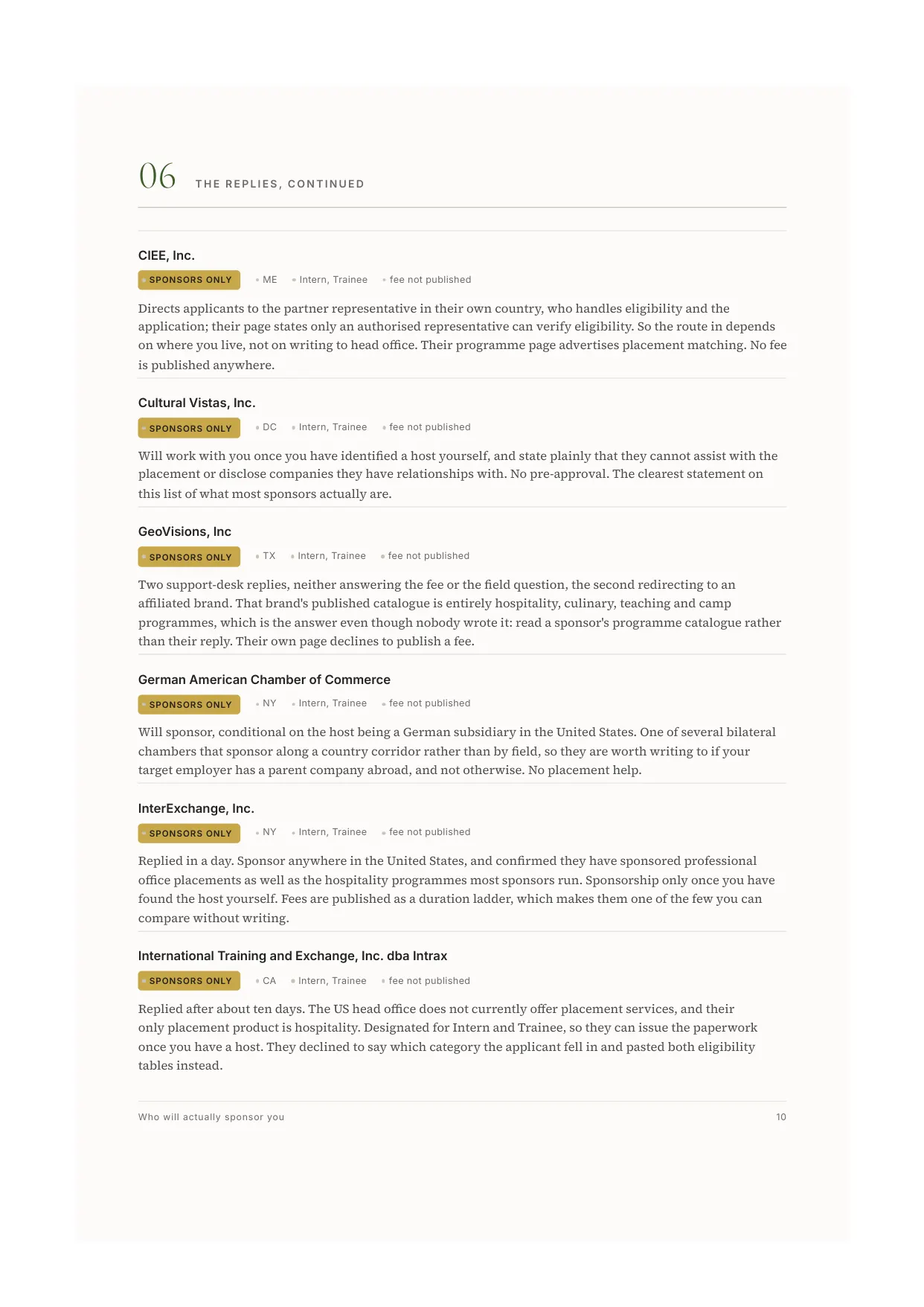
Every organisation that can sponsor a J-1 Intern or Trainee, what each one will and will not do for you, and what it costs. For any field, from any country.
- 114sponsors listed
- 29written to
- 15answered in full
- 18pages
$9one payment, and the file is yours
Sponsor quotes are being rechecked before this file goes on sale. Ask me about this file.
Look inside
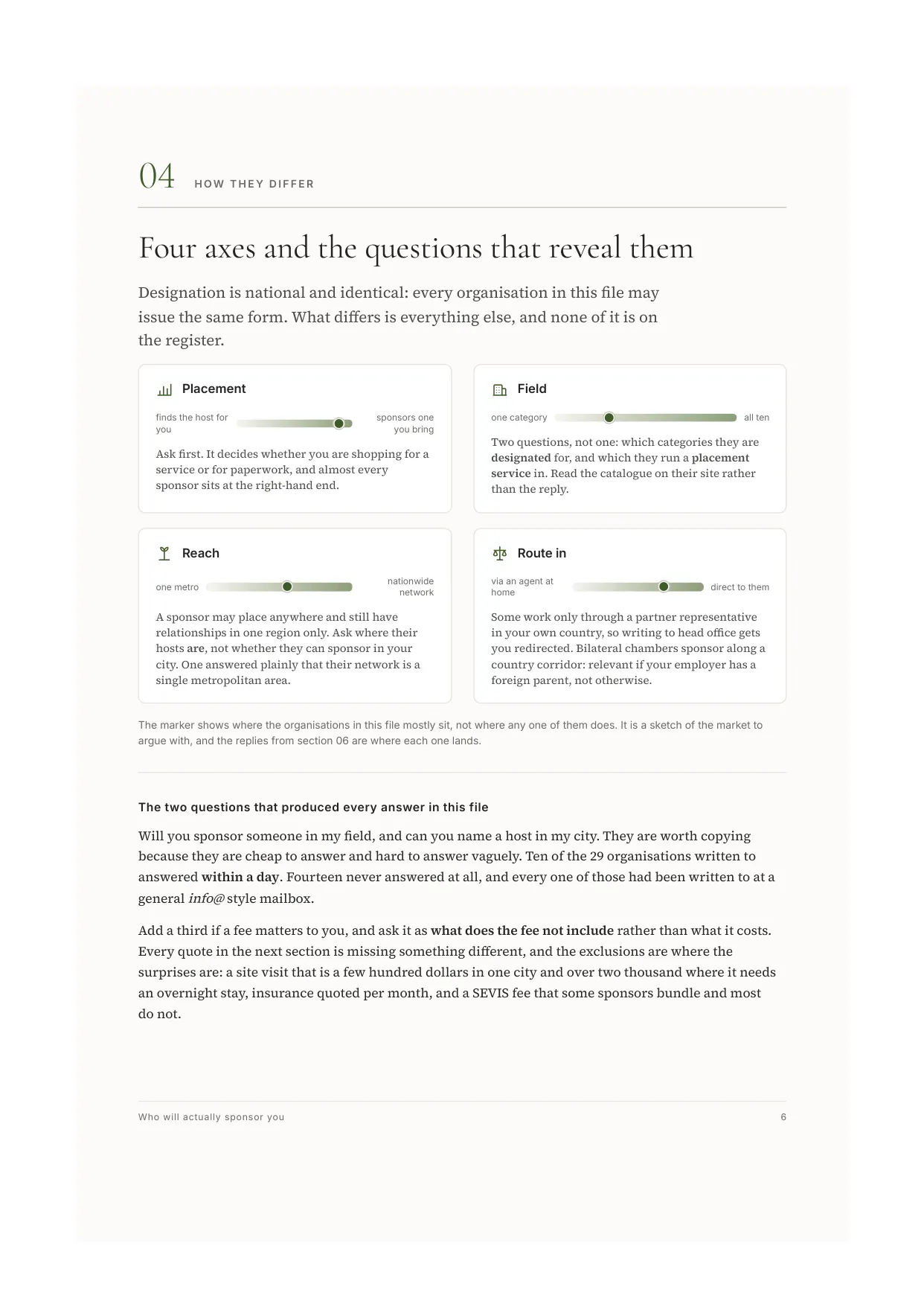
All 3 pages, full size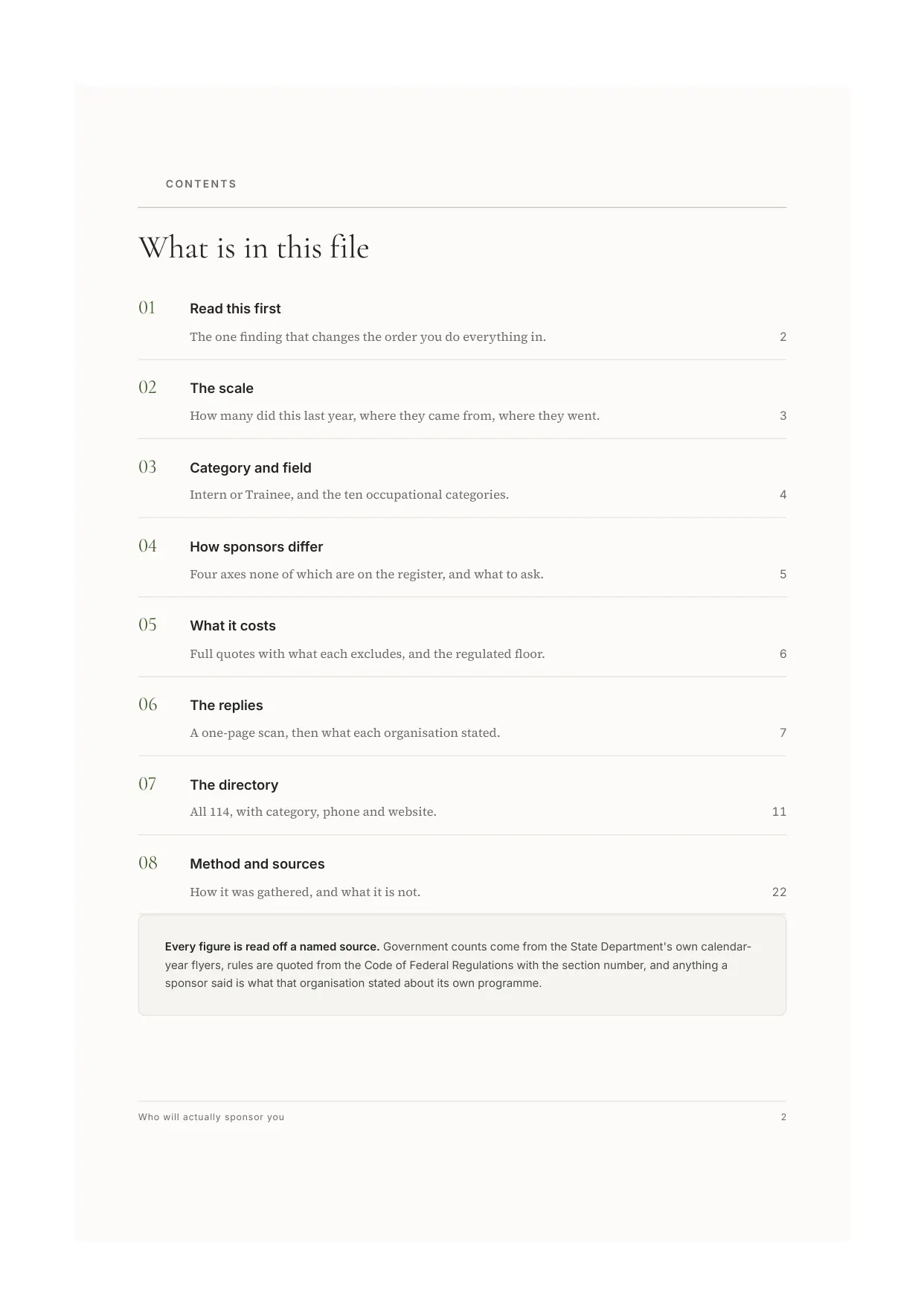
Sources12 sources, cited 22 times in this post
- ↑U.S. Department of State - Exchange Visitor VisaApplicants first obtain programme acceptance. Sponsors provide DS-2019 after SEVIS registration; interns and trainees also need DS-7002. The page describes DS-160, the non-refundable $185 application fee, nationality-specific issuance fees and consular instructions that may differ in order. It states that a visa does not guarantee admission and new exchange visitors cannot enter more than 30 days before the programme start.CheckedSep 22, 2026 · cited 5 times
- ↑22 CFR Part 62 - Exchange Visitor ProgramSections 62.10(b)(5)-(7) require advance disclosure of itemised fees and other costs. Section 62.12 governs sponsor issuance of DS-2019. Section 62.14 requires programme-period insurance, including $100,000 medical benefits, $25,000 repatriation, $50,000 evacuation, a $500 maximum deductible per accident or illness and up to 25% co-insurance; it provides several acceptable coverage arrangements and requires termination for willful noncompliance. Section 62.16 permits programme employment compensation and makes unauthorised employment subject to termination.CheckedSep 22, 2026 · cited 5 times
- ↑ICE - I-901 SEVIS FeeThe fee table lists J visa applicants (full payment) at $220, special J categories at $35, government visitors at $0, and F or M applicants at $350. This is the SEVIS fee, not a complete visa or travel budget.CheckedSep 22, 2026
- ↑22 CFR 22.1 - Schedule of Fees for Consular ServicesItem 21(a) lists the non-petition-based nonimmigrant visa application fee, except E category, at $185 per person. Item 22(b) exempts official U.S. Government sponsored educational and cultural J exchanges. Item 23 lists the issuance fee as reciprocal. These applicant fee entries do not establish every possible cost of hosting.CheckedSep 22, 2026 · cited 2 times
- ↑U.S. District Court, D. Mass. - 14 September 2026 order, No. 26-13799-FDS, Doc. 50 (copy hosted by plaintiff NAFSA)Pages 46-48 address nationwide relief. The court grants the motion to postpone the effective date of the final rule under 5 U.S.C. 705; vacatur and other relief are denied without prejudice. Signed and filed 14 September 2026. This is preliminary relief, not permanent repeal.CheckedSep 22, 2026
- ↑State Department final rule - Visas: Visa Bond ProgramThe rule states an effective date of 3 August 2026 and authorises bonds up to $20,000 for covered B-1/B-2 temporary visitors for business or pleasure. Its stated visa scope is B-1/B-2, not J.CheckedSep 22, 2026
- ↑State Department temporary final rule - expedited B1/B2 interview appointment feeThe rule specifies a $750 expedited interview appointment service only for B1/B2 applicants at limited posts and in limited quantities, with appointments within ten business days. Its stated effective period is 1 July through 31 December 2026. It does not establish a J-1 expedited service.CheckedSep 22, 2026
- ↑State Department - Public Notice of Revised Exchange Visitor Skills ListThe list applies from 9 December 2024 and supersedes the 2009 list. Vietnam is absent from its country list, whose final entries are Venezuela, Yemen and Zambia. People subject solely through a country designation on an older list are no longer subject through that designation if the country is absent from this revision. The 2009 country list was not re-reviewed.CheckedSep 22, 2026
- ↑Office of the Law Revision Counsel - 8 U.S.C. 1182(e), INA 212(e)Section 1182(e) identifies three grounds: direct or indirect programme funding by the U.S. government or the government of nationality or last residence; a relevant country and field designation on the Skills List at admission or acquisition of status; or graduate medical education or training. It also provides for waivers. Nationality alone does not settle every ground.CheckedSep 22, 2026 · cited 2 times
- ↑DHS final rule of 17 July 2026 - admission periods (effective date postponed)The published final rule set a 15 September 2026 effective date and would replace duration-of-status admission with fixed periods for F and J visitors, generally programme length capped at four years. This document establishes what DHS published, not that the rule took effect. The 14 September court order postpones its effective date.CheckedSep 22, 2026
- ↑U.S. Department of State - designated sponsor searchThe directory supports searches by programme, sponsor name and state and displays designated sponsors with contact details. Official sponsor addresses do not restrict where they may place participants.CheckedSep 22, 2026
- ↑U.S. Department of State - Exchange Visitor Program programmesThe programme page links to categories including Au Pair, Intern, Research Scholar and Summer Work Travel. Its additional STEM Initiatives link is not evidence of a separate sixteenth regulatory category.CheckedSep 22, 2026